
CMMC Phase 2 Arrives in 2026: How to Prepare?
What Actually Changes in 2026?
- Level 2 third-party assessments (C3PAO) become common for contracts that involve CUI.
- Self-attestation is no longer sufficient for most environments that handle.
- Documentation quality and evidence become just as important as the controls themselves.
- Supply-chain pressure increases as primes start expecting their subcontractors to prove compliance, not just promise it.
What Smart Contractors Are Doing Right Now
Preparing for C3PAO Scrutiny
- Run a mock assessment to find gaps early.
- Map each control to specific evidence (screenshots, tickets, logs, policies, training).
- Turn the SSP into a clear, accurate story of your environment not a generic template.
- Remove “TBD” language and unrealistic wish lists.
Building Real Continuous Monitoring
- Use automated scanning to catch misconfigurations and drift.
- Add continuous control monitoring for MFA, logging, backups, EDR, etc.
- Align change control with how work actually gets done.
- Give every POA&M item an owner, date, and proof of progress.
- Auditors expect you to operate as if an assessment could happen anytime.
Right Sizing Your CUI Boundary
- Segment networks so CUI lives in a defined enclave.
- Move CUI workloads into FedRAMP-authorized cloud services where possible.
- Reduce unmanaged devices and local storage touching CUI.
- Apply Zero Trust: strong identity, least privilege, continuous verification.
Managing Supply-Chain Pressure
- Ask partners for real evidence (scores, summaries, letters), not vague claims.
- Update subcontracts with CMMC expectations and timelines.
- Replace vendors who can’t meet minimum security requirements.
- Give suppliers templates and clear requirements so they can move with you.
How Long Does Level 2 Really Take in 2026?
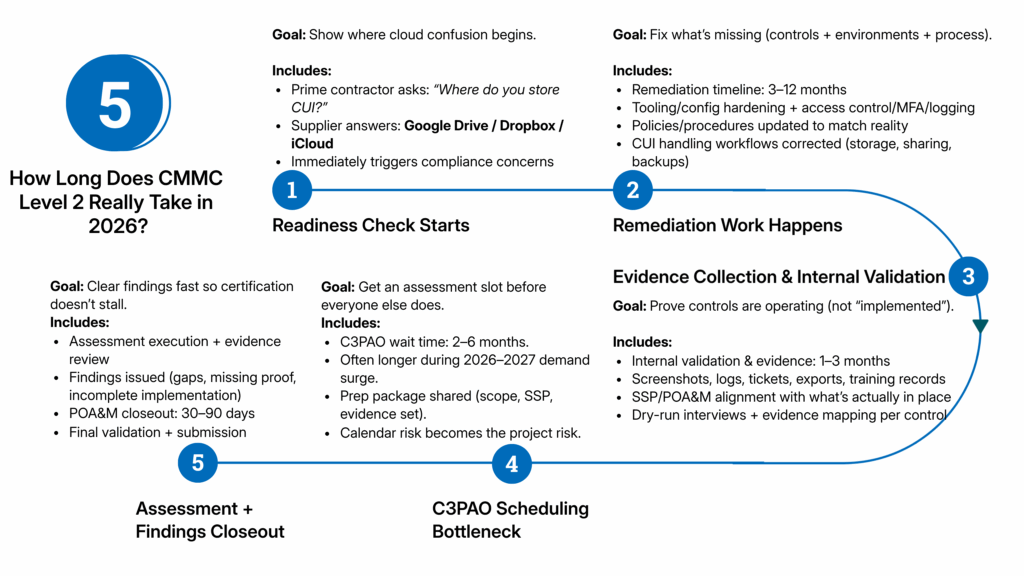
- Remediation: 3–12 months (depending on how close you are to NIST 800-171 today)
- Internal validation & evidence collection: 1–3 months
- Scheduling with a C3PAO: 2–6 months wait time, longer during the 2026–2027
- Scheduling with a C3PAO: 2–6 months wait time, longer during the 2026–2027
- Addressing findings / POA&M closeout: 30–90 days
- Assessor availability
- Contract deadlines
- Budget surprises
Inside a Phase 2 Audit: What Auditors Will Expect to See
A. Clear, Honest SSP
Exact systems and boundaries where CUI lives
What’s inherited vs. what you manage
Controls mapped to real implementations and evidence
B. Evidence for Every Claim
Diagrams, tickets, logs, configs
Policy and training records
Backup, MFA, logging, and EDR proof
Incident-response documentation
C. Operational Consistency
MFA turned on for every privileged account
Patching and log retention matching stated policies
Incident response steps matching the real environment
Why Early Certification Becomes a Competitive Advantage
Win Request for Proposals Faster
When RFPs start requiring third-party certification, early adopters can bid immediately while others are still fixing gaps and waiting for assessors.
Become the “Low-Risk” Partner
Primes are sorting suppliers into:
- Ready, low-risk, easy to work with
- Not ready, risky, likely to cause delays
Spend Less, Stress Less
- Spread costs over time
- Choose tools deliberately instead of under deadline pressure
- Avoid last-minute consulting premiums and fire drills
Transparent CMMC Pricing That Fits Your Level
At Cyber Security Solutions (CSS), we help contractors meet exactly the level that applies; no upsells, no inflated packages, no jargon.
Our pricing is fully transparent and scales with your team size and compliance scope:
Startup Plan — $200 / month / device (Level 1)
For small business teams. Covers up to 3 devices with managed firewall, VPN, SOC monitoring, encryption, and compliance dashboard.
CSS Enclave Plan — $1,250 / month (Level 1 & 2)
For growing teams (4–10 devices) needing full Level 2 alignment and 24/7 U.S.-based SOC support.
CSS Net Plan — $2,100 / month (Level 2 readiness)
For larger organizations (11–25 devices) needing continuous monitoring, documentation management, and enterprise-level control.
Ready to close your business gap?
Schedule a meeting with an expert