


Table of Contents
A controller is waiting on invoice approval because MFA access broke after a phone upgrade. The help desk is juggling password resets, a laptop setup, and an email quarantine request, while a contractor is trying to protect FCI and CUI without slowing production.
That’s why IT managed services challenges matter now. Delayed approvals, downtime, audit exposure, and unclear ownership all hit daily operations.
Gartner-related research notes that 74% of organizations believe security skill gaps have a moderate to severe negative impact on achieving 2025 objectives. We see managed services work best when support, security, compliance evidence, patching, and access control run as one operating rhythm.
Robert Langley, Business Developer at Cyber Security Solutions, notes: “If a ticket fix weakens access control or loses evidence, it’s not really fixed; support has to protect the workflow and the audit trail.”
Managed Services Challenges That Show Up In Daily Workflows
The first signs of trouble usually appear in routine workflows before they show up in board reports. A billing deadline slips, a new hire waits for access, or a client email sits in quarantine while nobody owns the next step.
-
Ticket queues stall: Unresolved access, device, and email issues slow billing, onboarding, and client response. A paralegal can’t reach matter files, or a controller can’t approve a vendor payment.
-
Patching gets inconsistent: Delayed updates leave endpoints exposed and create audit questions. Open source risk adds pressure, with 91% of codebases containing components that have had no new development in over two years.
-
Access rules drift: Old accounts, shared credentials, and unclear role-based access create risk when staff change roles, vendors leave, or shared mailboxes become permanent workarounds.
-
Compliance evidence scatters: Screenshots, policies, logs, and POA&M items become hard to retrieve during assessments.
These managed services challenges are easier to control when patch management, identity management, compliance dashboards, and help desk workflows are built into service delivery instead of treated as surprise add-ons.
IT Managed Services Provider Challenges Around Security Ownership
Security ownership becomes unclear when tools, people, and compliance records sit in different places. That’s where IT managed services provider challenges become operational, not theoretical. A SOC alert has to connect to a user, device, deadline, and business process.
Capacity matters, too: 4 out of 5 non-platform organizations say their security operations cannot effectively deal with the sheer quantity of threats and attacks. We run MSP and MSSP functions together because security operations only help when someone can turn an alert into a ticket, containment step, policy update, and assessment-ready evidence.
-
Alert response needs business context: SOC alerts need enough context to separate real incidents from noise. A login alert from a traveling executive is different from a finance mailbox rule created before a wire approval.
-
Endpoint protection needs follow-through: EDR or XDR works better when it connects to patching, device hardening, and help desk action. 39% of MSPs report major setbacks when adapting to advanced security technologies.
-
Remote access creates exposure: VPN and secure remote access need clear rules for distributed teams, contractors, and after-hours work. Third-party risk adds pressure; over the past five years, major supply chain and third-party breaches quadrupled, according to IBM.
-
Email threats reach finance: Phishing defense, email encryption, and training protect approval workflows from wire fraud, client data exposure, and delays.
-
Mobile devices remain unmanaged: Mobile device protection, including IBM-supported management where appropriate, keeps phones and tablets inside the same access and response process.
Managed Services Providers Challenges In Regulated Environments
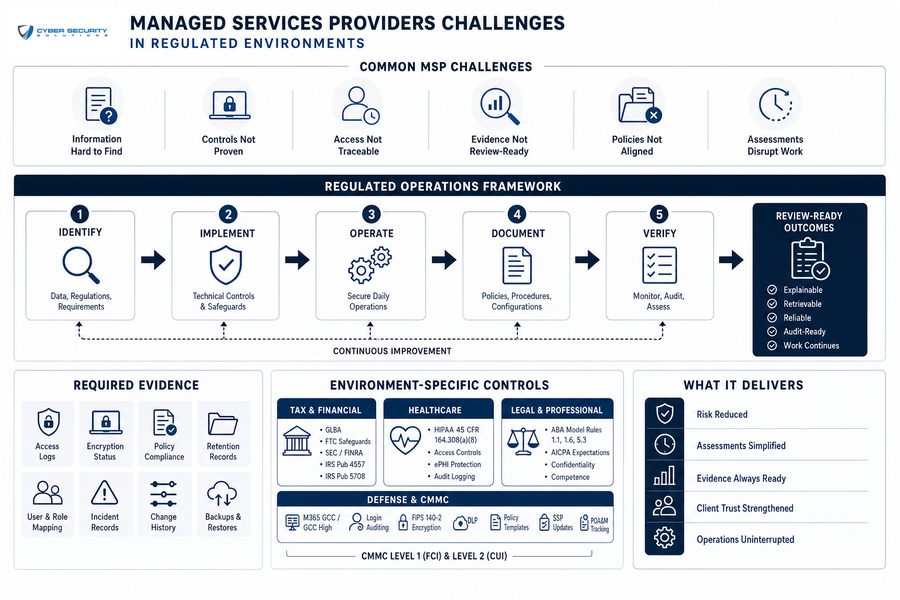
A tax preparer handling taxpayer data during filing season doesn’t need a policy binder nobody can use. Staff need secure access, working backups, protected email, and evidence that aligns with IRS Publication 4557 and IRS Publication 5708. The same pattern applies to HIPAA 45 CFR 164.308(a)(8), GLBA, FTC Safeguards, SEC, FINRA, ABA Model Rules 1.1, 1.6, and 5.3, AICPA expectations, and CMMC.
These managed services providers challenges come down to translation. Regulated work requires technical controls and readable documentation because an assessor, examiner, or client auditor needs to see how each control works. For defense work, CMMC Level 1 supports FCI safeguarding, while Level 2 for CUI requires deeper evidence, access control, and NIST SP 800-171 alignment.
That means Microsoft 365 GCC or GCC High configuration, login auditing, FIPS 140-2 validated encryption, data loss prevention, policy templates, SSP updates, and POA&M tracking all need clear owners. If evidence lives in inboxes and screenshots, contract readiness slows, approvals
Build Your Managed IT Foundation
Reduce Managed IT Friction
Turn support, access, and audit challenges into a clearer IT plan with Cyber Security Solutions.
IT Managed Services Challenges In Cloud And Microsoft 365 Operations
Cloud work is no longer just licensing and storage. It affects permissions, retention, encryption, collaboration, and audit evidence. That’s why our Managed Cloud Services include practical support for users and compliance reviewers, especially when Microsoft 365 GCC or GCC High decisions affect FCI, CUI, audit logs, and evidence retention.
-
Licensing affects control: The wrong licensing model can limit security, retention, or compliance features.
-
Permissions spread quickly: Unmanaged sharing in Microsoft 365 can expose client data, FCI, or CUI when users forward links instead of using approved workspaces.
-
Backups need ownership: Cloud services still require managed backup, recovery planning, and restoration testing.
-
Configuration needs evidence: Audit logs, identity settings, DLP, and conditional access support compliance reporting.
-
Support must be practical: Help desk workflows should help users regain access, share files, and restore work without bypassing MFA, encryption, or approval controls.
Cloud administration also creates a staffing problem when help desk teams must support users, secure configurations, and produce audit evidence at the same time, with 69% saying their team lacks the skills needed to be proficient at managing cloud applications.
Fix IT Friction Before It Spreads
Turn daily support, security, and compliance challenges into a cleaner operating rhythm with Cyber Security Solutions.
Service Delivery Gaps That Mature IT Programs Need To Close
Change is hard because staff still need to work, clients still need answers, and compliance deadlines do not pause. If everything is treated as equal, budget goes to noise while patching, access reviews, and evidence collection drift.
Prioritization also has cost and correlation context: respondents cite operational cost pressures at 45%, integration challenges at 42%, and difficulty correlating threats at 41%. We don’t believe every environment needs a rip-and-replace plan; when an incumbent IT provider is part of the right answer, the work should be coordinated in good faith with clear ownership.
-
Map ownership first: Identify who owns help desk tickets, SOC response, patching, access reviews, policy updates, and compliance evidence. A missed offboarding ticket shouldn’t leave a former user with mailbox access.
-
Standardize the stack: Consolidate endpoint protection, firewall management, DNS filtering, identity controls, and secure remote access where practical. Market data shows Around 30% report partial consolidation, 19% say the majority of their infrastructure now sits under one platform, and 10% have achieved full consolidation.
-
Document operating procedures: Use CMMC/NIST 800-171 policy templates, SSP support, POA&M management, and recurring review schedules so evidence is ready before an assessor or examiner asks for it.
-
Refresh hardware deliberately: Hardware-as-a-Service in our Standard, Business, and Enterprise tiers, with 3- to 5-year endpoint refresh cycles and 5- to 7-year infrastructure refresh cycles, reduces budgeting friction. All-inclusive pricing keeps known services accounted for up front.
A Practical Path To Stronger Managed IT
Stronger managed IT gives your team clearer ownership, smoother support, stronger access control, better documentation, and a more reliable path through audits or assessments. It also keeps daily work moving, from invoice approvals delayed by MFA to SOC response, cloud reviews, and client file access.
At Cyber Security Solutions, we help align managed IT, security operations, cloud services, and compliance documentation in one practical operating model, including 24/7 SOC response, EDR/XDR, SIEM, identity management, secure gateway infrastructure, mobile security, Microsoft GCC or GCC High support, and continuous evidence collection where appropriate.
If you want a clear view of ownership, cloud configuration, compliance documentation, and security operations, contact Cyber Security Solutions and we’ll help you turn those moving parts into one workable plan.