



Table of Contents
Managed IT Pricing: What a Regulated Practice Really Pays, and What It Should Get
The renewal email lands while payroll is waiting for approval, and the cyber insurance form asks whether MFA, vulnerability scanning, written security policies, and incident response steps are in place. The current IT invoice lists help desk support, backups, and antivirus, but nobody can tell whether the evidence exists.
That gap is why managed IT services pricing needs more than a monthly number. For regulated practices, IT support has to connect daily tickets, devices, licenses, and compliance records to operational continuity, defensible evidence, and clear accountability. This guide shows how pricing models work, what gets left out, and how to compare quotes fairly.
Justin Martin, Business Developer at Cyber Security Solutions, notes: “A fair IT quote should show what is protected, what is documented, what is excluded, and who answers when an auditor or insurer asks for proof.”
How Managed IT Services Rates Are Usually Built
Similar quotes often price different responsibilities. One proposal may cover ticket response for laptops, while another includes licensing, monitoring, compliance documentation, and documented exclusions. Good managed IT pricing makes those tradeoffs visible.
-
Per device pricing: Billing follows laptops, desktops, servers, and specialized devices such as imaging workstations.
-
Per user pricing: Useful for steady staffing, but it can miss shared terminals, servers, mobile devices, and protected systems without assigned users.
-
Tiered bundles: Tiers simplify budgeting when inclusions, limits, licensing, compliance responsibility, and exclusions are written clearly.
-
Break-fix billing: Hourly repair support pays for repair events, but it usually excludes risk assessments, scanning, and written compliance evidence.
What Managed IT Costs Must Cover In A Regulated Practice
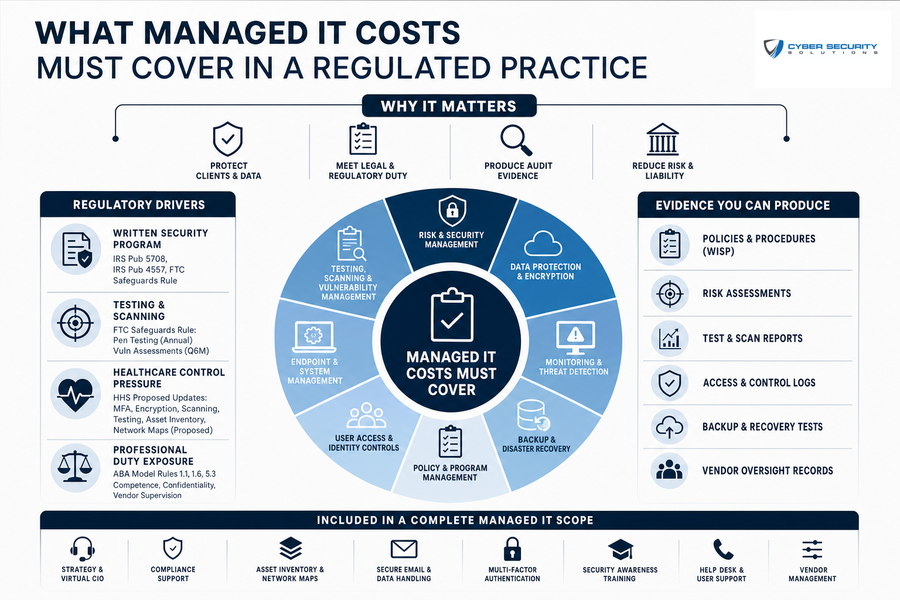
Regulated practices aren’t only paying for uptime. They’re paying for evidence that controls exist, are monitored, and can be explained during an audit, client inquiry, insurance review, or regulator examination. When leaders ask how much does managed IT services cost, the better question is what evidence and accountability the monthly number includes.
-
Written security program: IRS Pub 5708, IRS Pub 4557, and the FTC Safeguards Rule shape written information security program expectations.
-
Testing and scanning: The FTC Safeguards Rule addresses annual penetration testing and vulnerability assessments every six months, so quotes should state whether testing, remediation tracking, and reporting are included.
-
Healthcare control pressure: HIPAA 45 CFR 164.308(a)(8) addresses regular evaluation of security measures, and HHS proposed updates include MFA, encryption, vulnerability scanning, penetration testing, annual asset inventory, and a network map. These updates are proposed, not final.
-
Professional duty exposure: ABA Model Rules 1.1, 1.6, and 5.3 point to technology competence, confidentiality, and vendor supervision.
Plan Your Managed IT Investment
Where A Managed IT Services Price List Can Mislead
A low monthly number helps only when you know what’s included, what’s excluded, and what gets billed later. Gaps often come from unclear scope, licensing limitations, or split accountability.
A dental office may have imaging workstations, practice management software, encrypted email needs, and cyber insurance questions sitting on the same renewal deadline. If those systems aren’t named in the quote, nobody knows whether they’re protected, excluded, or paid add-ons.
-
Security as an upsell: Some MSP quotes cover support first and security later.
-
Two-vendor confusion: At 2 AM, unclear contracts slow investigation and containment.
-
Licensing gaps:Microsoft 365 Business Premium includes Intune Plan 1, Defender for Business, and advanced Entra ID; Basic and Standard do not.
-
Hardware age risk: Older endpoints and infrastructure drive repeat tickets, downtime, and security exposure when refresh planning is left out.
Using A Managed IT Services Calculator Without Missing Scope
A managed IT services calculator helps model monthly cost when you can select compliance level, users, and devices in real time. It still has to connect price to capability, limitations, and exit provisions.
Price comparison should move into capability review before a contract is approved.
Review device count, user count, licensing configuration, and compliance scope.
-
Device inventory drives cost: Count endpoints, servers, mobile devices, shared workstations, and systems tied to line-of-business software.
-
User count changes workload: Include onboarding, offboarding, identity management, MFA, and access reviews.
-
Compliance level changes scope: CMMC Level 1 or Level 2, HIPAA, GLBA, or PCI DSS changes evidence work and monitoring expectations.
-
Licensing determines controls: Microsoft licensing affects whether identity, device management, and reporting controls are available.
-
Contract term affects budget: Predictability improves when hardware inclusion, refresh planning, and monthly scope are visible before approval.
A Managed IT Services ROI Calculator Should Include Risk
ROI is more than avoided downtime. A managed IT services ROI calculator should include fewer repeat tickets, cleaner cyber insurance answers, planned workstation refreshes, audit readiness, and one accountable team owning incident response evidence where included in scope.
-
Recurring ticket reduction: Track whether the same printer, VPN, workstation, or application tickets decline.
-
First call resolution: Measure whether staff return to client work without repeated escalations.
-
Client retention signal: Stable support protects time-sensitive files, records, and compliance workflows.
-
Scale of support: CSS operates as both MSP and MSSP, owning and operating the security stack where compliance evidence matters.
Price IT Around Real Compliance Needs
Get clarity on managed IT scope, accountability, and compliance evidence with Cyber Security Solutions.
Cyber Security Solutions Managed IT Services Pricing By Tier
Published pricing helps a practice compare scope instead of guessing what’s behind an invoice. Above Micro, our managed tiers embed security and compliance, with hardware included where shown and no surprise add-ons when scope is documented up front.
|
Tier |
Devices |
Price |
Term |
Hardware |
Compliance |
|---|---|---|---|---|---|
|
Micro |
1 to 3 |
$200/device/month |
1 year |
Not included |
Essential compliance |
|
Standard |
3 to 10 |
$995/month total |
3 years |
Included |
HIPAA/GLBA/PCI-DSS |
|
Business |
11 to 25 |
$2,150/month total |
3 years |
Included |
HIPAA/GLBA/PCI-DSS |
|
Enterprise |
26 plus |
Custom |
Custom |
Included |
Custom |
Pricing reflects standard published rates and may vary based on scope, device count, environment complexity, and specific compliance requirements. Hardware-included tiers require a 3-year service agreement. Custom pricing applies to Enterprise engagements (26+ devices). All pricing is subject to change. Contact CSS for a detailed quote based on your specific environment.
Compliance program scope and available attestations depend on the service tier and licensing configuration selected…
Hardware-as-a-Service includes refresh cycles built in: 3 to 5 years for endpoints and 5 to 7 years for infrastructure. That matters when aging laptops, firewalls, and servers are already creating tickets or forcing surprise purchases.
How Much Does Managed IT Services Cost When Accountability Is Split
Separate vendors can work when roles are documented before an incident, audit request, or insurance question arrives. We don’t push, rip and replace when co-managed support is the better fit.
For context, HHS OCR resolution agreements list September 17, 2026: Ambry Genetics Corporation, $700,000, after a phishing attack exposed 225,000 patients’ health data.
-
Incident ownership at night: Name who investigates, who communicates with leadership, and who approves containment.
-
Compliance evidence responsibility: Assign screenshots, policies, scan results, inventories, access reviews, and remediation notes.
-
Cyber insurance application accuracy: We review applications and warranties because claims can be challenged when the represented security posture does not match reality.
-
Licensing and control alignment: Unsupported licensing creates gaps between promised controls and available tools.
-
Hardware replacement planning: Refresh cycles reduce surprise purchases and aging device risk.
Practical Questions Before You Sign A Managed IT Contract
Changing IT arrangements disrupts workflows, open tickets, device support, and long-standing provider relationships worth preserving. Start with ticket history, device lists, licensing inventory, and your current contract.
-
Confirm platform ownership: Ask who owns and operates EDR, SIEM, MDM, identity management, and secure gateway tools.
-
Separate included from extra: Ask what is included versus billed separately, including assessments, documentation, testing, and after-hours response.
-
Map licensing to controls: Ask which Microsoft tier supports the promised compliance controls.
-
Document incident roles: Ask who leads response, reporting, containment, recovery, and communication.
-
Review exit terms: Confirm limitations, service scope, and exit provisions before signing.
Choose Pricing That Matches Your Compliance Reality
The right comparison includes IT support, security operations, compliance work, hardware planning, licensing, and incident accountability. Contact Cyber Security Solutions to review device counts, service tiers, and scope, including Track 3 consultation for regulated practices and continuous evidence collection for CMMC-relevant environments where applicable.
Where included in scope, CSS operates as both MSP and MSSP across security operations, endpoint detection and response, SIEM, identity management, mobile security, and secure gateway infrastructure. Security Ready. Compliance Ready. Always Ready.
Cybersecurity and compliance requirements vary by jurisdiction, industry, business model, and technology environment. CSS does not provide legal advice. Consult qualified legal counsel for advice about your specific regulatory obligations.